

2026 Reality - AI is a retention tool, not just a productivity tool
January 9, 2026 | Article
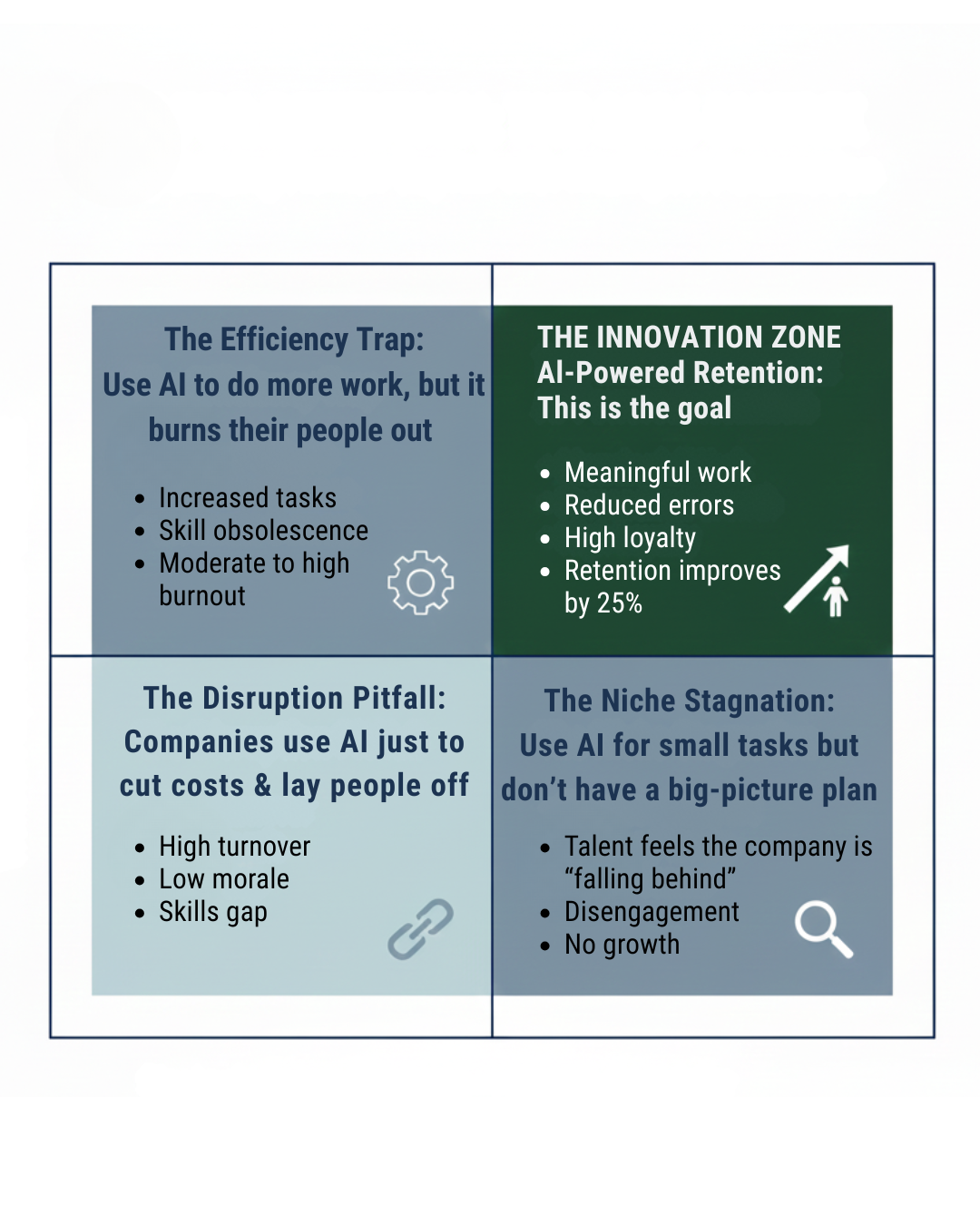
Moving Into the Innovation Zone
Most business leaders think they are winning the AI race because their productivity is up. But if you look at the data, a dangerous trend is emerging: The Efficiency Trap. Companies are using AI to compress tasks, only to immediately fill that saved time with more tasks. You’re getting more output, but you’re losing your best people to burnout. In 2026, the goal isn't to work less; it's to stop wasting expensive human talent on $15/hour tasks.
At Huff Consulting, we help you pivot from "Efficiency" to "The Innovation Zone." Here is how we use AI as a retention engine:
Why your 2026 AI strategy is secretly causing your best people to quit.
Pivoting from efficiency to strategic value creation
The introduction of Generative AI capabilities presents a critical inflection point for organizational leadership. The prevailing strategic error is leveraging this newfound capacity for mere volume increase—the Efficiency Trap. The forward-thinking enterprise does not view AI as a time-saving mechanism, but as an engine for reallocation of human capital. By automating routine administrative tasks, AI effectively exposes and unlocks hidden talent capacity within the high-skill workforce.
The 2026 strategic imperative: capacity reallocation
The strategic goal is not to maximize employee activity; it is to maximize the return on investment (ROI) of your most expensive human assets. Routine administrative tasks are characterized by a low ceiling for profitability and offer diminishing returns. Strategic deep work—encompassing complex problem-solving, proactive client relationship cultivation, and long-range planning—possesses an unlimited ceiling for profitability. If your high-level talent is currently dedicating an estimated 40% of their cognitive energy to tasks amenable to machine automation, you are not simply losing time; you are forfeiting the strategic value-add they were hired to deliver.
Our 2026 Roadmap shifts your organizational energy:
From: Task processing and reactive administration.
To: High-value deep work and sustained strategic execution.
We enable leaders to leverage AI to convert operational savings directly into strategic capacity, ensuring that the value derived from high-level talent is commensurate with its cost.
Proactive retention intelligence
AI doesn't "read minds." It looks at digital exhaust—the trail of data we all leave behind while working.
Communication Lag: If a high-performer usually responds to emails in 20 minutes but is now taking 4 hours, that’s a "lag signal."
Tone Shifts (NLP): Natural Language Processing detects if a person’s writing style has shifted from "proactive/collaborative" (e.g., "How can we solve this?") to "short/reactive" (e.g., "Just tell me what to do").
Meeting Saturation: It tracks "Cognitive Load." If an employee has 6 hours of back-to-back Zoom calls for three days straight, the AI flags a "burnout risk score" because the human brain cannot sustain that.
Off-Hours Activity: It notices if someone is suddenly logging in at 11 PM every night when they never used to.
High-turnover costs aren't just a "personnel issue"; they are a massive financial leak. In 2026, we use AI to identify workforce friction before it leads to a resignation. By analyzing anonymized communication trends and workload saturation, we can spot teams that are becoming "red-lined" and move to protect your investment. A stressed-out employee makes 40% more errors and works 30% slower. If AI can tell us that your top salesperson is hitting a wall, you can adjust their schedule for a week to save a $100k-per-year asset. That’s just good business.
AI driven “internal mobility”
The #1 reason people leave is "lack of growth." AI is uniquely positioned to bridge the informational asymmetry between employee aspirations and organizational needs by analyzing the "Digital Exhaust" of the workforce:
Hidden Skill Mapping: The AI system analyzes an employee's contributions across diverse projects, communication patterns, and training data to construct a comprehensive profile of their "adjacent skill set"—skills not visible on a static resume.
Opportunity Matching: It then maps these emergent skills to unfulfilled needs within the organization, such as strategic initiatives, cross-functional projects, or temporary assignments, effectively creating internal career pivot points.
Proactive Flagging: The system can proactively flag high-potential employees in roles nearing burnout or displaying early attrition signals, recommending targeted internal moves as a retention intervention.
The statistical evidence clearly demonstrates the value of this internal focus: Employees who transition into new roles internally exhibit a 75% greater probability of remaining with the organization. This AI-driven approach delivers a powerful, dual-pronged financial benefit:
Mitigation of Attrition Cost: By facilitating career pivot points without a company departure, you eliminate the substantial financial burden associated with external recruitment, onboarding, and the ramp-up time of a new hire.
Maximization of Talent Investment: You preserve and deepen the organization's investment in its most valuable asset—employees with institutional knowledge—by providing them with continuous, engaging, and skill-aligned development.
In essence, AI transforms the talent pipeline from a costly leakage point into a self-sustaining, resilient internal talent engine.
The Bottom Line: If you use AI solely to do "more with less," you are building a factory. If you use AI to do "better with less stress," you are building a legacy. Contact us today to get help building your business legacy!